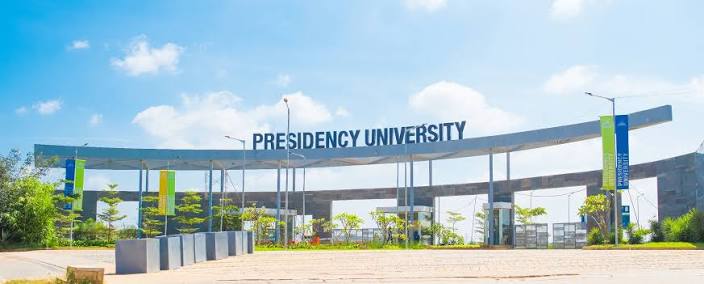
 University1 Photo
Presidency University FAQs | Admissions, Courses, Fees & Placements
Gain More Knowledge, Reach Greater Heights
Bengaluru, KarnatakaEstd. 2013Private Institute
Frequently asked questions
What is the duration of the BA Journalism and Mass Communication programme at Presidency University?
The Bachelor of Arts in Journalism and Mass Communication (BA JMC) is a 3-year full-time undergraduate programme consisting of 6 semesters.
What is the duration of the BBA programme at Presidency University?
The Bachelor of Business Administration (BBA) is a 3-year full-time undergraduate programme comprising 6 semesters.
What are the eligibility criteria for admission to the BBA programme?
Candidates must have passed 10+2 or an equivalent examination from a recognized board with a minimum of 45% aggregate marks. Students from Arts, Commerce, or Science streams are eligible to apply, subject to the university's admission guidelines.
What is the duration of the BBA LL.B. (Hons.) programme at Presidency University?
The Bachelor of Business Administration and Bachelor of Laws (Honours) is a 5-year integrated undergraduate programme consisting of 10 semesters.
What are the eligibility criteria for admission to the BBA LL.B. (Hons.) programme?
Candidates must have passed 10+2 or an equivalent examination from a recognized board with a minimum of 45% aggregate marks. Students from Arts, Commerce, or Science streams are eligible to apply, subject to the university's admission guidelines.
What is the duration of the BBA LLB (Hons.) programme?
The programme is a 5-year full-time integrated undergraduate degree.
What is the duration of the B.Com. programme at Presidency University?
The Bachelor of Commerce (B.Com.) is a 3-year full-time undergraduate programme comprising 6 semesters.
What is the duration of the Bachelor of Commerce (B.Com) programme?
The Bachelor of Commerce (B.Com) programme is a 3-year full-time undergraduate course designed to provide students with a strong foundation in commerce, accounting, finance, taxation, business management, and economics.
What is the eligibility criteria for B.Com admission?
Candidates must have completed 10+2 or an equivalent examination from a recognised Board or Council with a minimum of 40% aggregate marks to be eligible for admission to the B.Com programme.
What is the duration of the Bachelor of Computer Application (BCA) programme?
The Bachelor of Computer Application (BCA) is a 3-year full-time undergraduate programme.
What is the eligibility criteria for BCA admission?
Candidates must have completed 10+2 or an equivalent examination from a recognised Board with a minimum of 40% aggregate marks.
What is the duration of the Bachelor of Design (B.Des) programme?
The Bachelor of Design (B.Des) is a 4-year full-time undergraduate programme.
What is the eligibility for admission to the B.Des programme?
Candidates must have completed 10+2 or an equivalent examination from a recognised Board with a minimum of 45% aggregate marks. SC/ST candidates require a minimum of 40% aggregate marks, wherever applicable.
What is the duration of the Bachelor of Fine Arts (BFA) programme?
The Bachelor of Fine Arts (BFA) is a 4-year full-time undergraduate programme.
What is the eligibility for admission to the BFA programme?
Candidates must have completed 10+2 or an equivalent examination from a recognised Board with a minimum of 45% aggregate marks.
What is the duration of the Bachelor of Science programme?
The Bachelor of Science (B.Sc) is a four-year full-time undergraduate programme.
What is the eligibility for admission to B.Sc?
Candidates must have completed 10+2 or equivalent from a recognised Board or Council with a minimum of 50% aggregate marks.
What is the duration of the Bachelor of Technology programme?
The Bachelor of Technology (B.Tech) is a four-year full-time undergraduate engineering programme.
What is the eligibility for admission to B.Tech?
Candidates must have completed 10+2 or equivalent from a recognised Board or Council with a minimum of 45% aggregate marks. SC/ST candidates require a minimum of 40% aggregate marks.
What is the duration of the Diploma in Arts & Humanities?
The programme is completed in one year through full-time study.
What is the eligibility for admission to the Diploma in Arts and Humanities?
Candidates must have completed 10+2 / PUC or an equivalent qualification from a recognized board. Admission is generally based on academic merit and the university's eligibility criteria.
What is the duration of the Executive MBA programme?
The Executive MBA is a 2-year full-time postgraduate programme.
Who is eligible to apply for the Executive MBA programme?
Candidates must hold a Bachelor's degree from a recognized university with the minimum prescribed marks. Relevant professional work experience may also be preferred or required, depending on the university's admission guidelines.
What is the duration of the Master of Arts programme?
The Master of Arts (MA) is a 2-year full-time postgraduate programme.
What are the eligibility criteria for admission to the M.A. programme?
Candidates must possess a Bachelor's degree in the relevant discipline from a recognized university with a minimum of 50% aggregate marks (or as prescribed by the university). Admission is generally based on academic merit and fulfillment of the university's eligibility requirements.
Who is eligible for admission?
Candidates must hold a Bachelor's degree with at least 50% aggregate marks (45% for SC/ST candidates) from a recognised university.
What is the duration of the MA Journalism & Mass Communication programme?
The programme is completed over 2 years as a full-time postgraduate degree.
What is the duration of the MBA programme?
The Master of Business Administration (MBA) is a 2-year full-time postgraduate programme.
What are the eligibility criteria for admission to the MBA programme?
Candidates must hold a Bachelor's degree from a recognized university with a minimum of 50% aggregate marks (45% for reserved categories, where applicable). Admission is generally based on CAT, MAT, XAT, CMAT, KMAT, Karnataka PGCET, or other accepted entrance examinations, along with the university's selection process.
What is the duration of the M.Com. programme at Presidency University?
The Master of Commerce (M.Com.) is a 2-year full-time postgraduate programme consisting of 4 semesters, with a focus on advanced commerce, finance, accounting, taxation, and research.
What are the eligibility criteria for admission to the M.Com. programme?
Candidates must possess a Bachelor's degree in Commerce (B.Com.) or a related discipline from a recognized university with a minimum of 50% aggregate marks (or as prescribed by the university). Admission is generally based on academic merit and fulfillment of the university's eligibility requirements.
What is the duration of the MCA programme at Presidency University?
The Master of Computer Applications (MCA) is a 2-year full-time postgraduate programme comprising 4 semesters, with extensive practical training, software development projects, and industry internships.
What are the eligibility criteria for admission to the MCA programme?
Candidates must hold a Bachelor's degree from a recognized university with a minimum of 50% aggregate marks (45% for reserved categories, where applicable). Applicants should have studied Mathematics, Statistics, Computer Science, Computer Applications, Business Mathematics, or Business Statistics at the 10+2 or graduation level, in accordance with the university's admission guidelines.
What is the duration of the LL.M. programme at Presidency University?
The Master of Laws (LL.M.) is a 1-year full-time postgraduate programme comprising 2 semesters, with a focus on advanced legal studies, research, and specialization.
What are the eligibility criteria for admission to the LL.M. programme?
Candidates must possess an LL.B. degree from a recognized university with a minimum of 50% aggregate marks (or as prescribed by the university). Admission is generally based on academic merit and fulfillment of the university's eligibility requirements.
What is the duration of the M.Sc. programme at Presidency University?
The Master of Science (M.Sc.) is a 2-year full-time postgraduate programme comprising 4 semesters, with a strong emphasis on laboratory training, research, and industry exposure.
What are the eligibility criteria for admission to the M.Sc. programme?
Candidates must possess a Bachelor's degree in the relevant science discipline from a recognized university with a minimum of 50% aggregate marks (or as prescribed by the university). Admission is generally based on academic merit and the university's eligibility guidelines.
What is the duration of the M.Tech. programme at Presidency University?
The Master of Technology (M.Tech.) is a 2-year full-time postgraduate programme comprising 4 semesters, with a strong focus on advanced engineering concepts, research, laboratory work, and industry-oriented projects.
What are the eligibility criteria for admission to the M.Tech. programme?
Candidates must possess a B.E./B.Tech. degree or an equivalent qualification in a relevant engineering discipline from a recognized university with a minimum of 50% aggregate marks (45% for reserved categories, where applicable). Admission is generally based on GATE, Karnataka PGCET, or other criteria prescribed by the university.
What is the duration of the Post Graduate Diploma programme at Presidency University?
The Post Graduate Diploma (PG Diploma) is typically a 1-year full-time programme comprising 2 semesters, focusing on practical, industry-oriented learning.
What are the eligibility criteria for admission to the Post Graduate Diploma programme?
Candidates must possess a Bachelor's degree from a recognized university with a minimum of 50% aggregate marks (or as prescribed by the university). Eligibility may vary depending on the chosen specialization and university admission guidelines.
What is the duration of the PG Diploma in Arts and Humanities at Presidency University?
The Post Graduate Diploma in Arts and Humanities is a 1-year full-time programme consisting of 2 semesters, with a focus on advanced humanities knowledge, research, and practical learning.
What is the duration of the Post Graduate Diploma in Management (PGDM) programme?
The Post Graduate Diploma in Management (PGDM) is a full-time programme of approximately 14–16 months, focusing on practical management education, industry exposure, and leadership development.
Is Presidency University Yelahanka approved by UGC?
Yes. Presidency University Yelahanka is recognized by the University Grants Commission (UGC) and approved by AICTE. Its law programmes are also approved by the Bar Council of India (BCI).
Which are the most popular courses at Presidency University Yelahanka?
B.Tech, MBA, BBA, BCA, B.Com, Law, Design, and M.Tech are among the most sought-after programmes.
How many programmes are offered by Presidency University Yelahanka?
The university offers more than 97 undergraduate, postgraduate, and doctoral programmes across multiple disciplines.
Which entrance exams are accepted for B.Tech admission?
The university accepts JEE Main, KCET, COMEDK UGET, and PUEET scores for B.Tech admissions.
Which entrance exams are accepted for MBA admission?
MBA admissions accept scores from CAT, XAT, MAT, CMAT, ATMA, KMAT, Karnataka PGCET, and PUMAT, followed by the university's selection process.
What is the placement record of Presidency University Yelahanka?
The university has reported a 99% placement rate, with the highest package reaching INR 16.43 LPA and an average package of INR 12 LPA.
Does Presidency University Yelahanka provide scholarships?
Yes. The university offers merit-based, sports, defence, need-based, government, and special-category scholarships to eligible students.
Does the university provide hostel facilities?
Yes. Separate hostel accommodation is available for boys and girls with modern amenities and campus security.
What are the major recruiters at Presidency University Yelahanka?
Leading recruiters include SAP, Deloitte, KPMG, Oracle, Capgemini, Wipro, TCS, Tech Mahindra, Infosys, and Accenture.
Why should students choose Presidency University Yelahanka?
Students choose Presidency University Yelahanka for its multidisciplinary programmes, industry-oriented curriculum, experienced faculty, modern infrastructure, strong placement support, research opportunities, scholarships, and national-level academic recognition.
Is Presidency University Yelahanka Admission 2026 open?
Yes. Presidency University Yelahanka Admission 2026-27 is currently open for undergraduate, postgraduate, and doctoral programmes. Candidates can apply online through the official admission portal until seats are filled.
Is admission to Presidency University based on merit or entrance exams?
Admissions are offered through both merit-based and entrance-based selection. The selection process depends on the programme chosen.
Can I apply without a national-level entrance exam score?
Yes. Candidates without a valid national or state-level entrance score can appear for university-level entrance exams such as PUEET, PUMAT, PAT, PDET, or PULAT, depending on the programme.
Does Presidency University offer management quota admission?
Yes. Management quota seats are available for B.Tech, MBA, and selected undergraduate programmes. Admission is based on PAT performance and a Personal Interview.
What is the eligibility for B.Tech admission?
Candidates must have passed 10+2 with Physics and Mathematics along with one optional subject such as Chemistry, Biology, Biotechnology, Electronics, or Computer Science, with the required minimum qualifying marks.
What is the eligibility for MBA admission?
Candidates must possess a Bachelor's degree from a recognised university with a minimum of 50% aggregate marks (45% for SC/ST candidates).
Can diploma holders get direct admission to the second year of B.Tech?
Yes. Eligible diploma holders can apply for lateral entry admission to the second year of the B.Tech programme as per AICTE guidelines.
How can I apply for Presidency University Admission 2026?
Candidates need to register online, complete the application form, upload the required documents, pay the application fee, and appear for the applicable entrance test or interview.
What documents are required during admission?
Generally required documents include: Class 10 and 12 mark sheets Graduation mark sheets (for PG programmes) Entrance exam scorecard Aadhaar Card Transfer Certificate Migration Certificate Passport-size photographs Signature Category certificate (if applicable)
Is there any state domicile quota for admission?
No. Presidency University does not provide a state domicile quota for institute-level admissions.
Can students awaiting their qualifying examination results apply?
Yes. Students awaiting their Class 12 or graduation results can apply provisionally. Admission is confirmed after submitting the qualifying marks before the prescribed deadline.
What is the application fee for Presidency University Admission?
Candidates are required to pay the prescribed application fee while submitting the application form. The fee is non-refundable after payment.
When should I apply for Presidency University Admission 2026?
Candidates should apply as early as possible because admissions are conducted on a rolling basis, and seats are allotted until the available intake is filled.
Does Presidency University Yelahanka offer scholarships?
Yes. Presidency University Yelahanka offers scholarships to eligible students based on academic merit, entrance exam performance, sports achievements, financial need, and special categories such as defence personnel, SC/ST, and physically challenged students.
Who is eligible for merit scholarships at Presidency University?
Students who score 80% or above in the qualifying examination are eligible for merit scholarships. Higher scholarship benefits are generally available for students scoring 90% and above.
Does Presidency University provide scholarships based on entrance exam scores?
Yes. The university offers scholarships based on performance in entrance exams such as JEE Main, CAT, MAT, XAT, CUET, KCET, and Karnataka PGCET, subject to the prescribed eligibility criteria.
What scholarships are available for KCET and Karnataka PGCET rank holders?
Students with excellent KCET or Karnataka PGCET ranks can receive tuition fee waivers. KCET Rank 1–1,000: Up to 100% tuition fee waiver KCET Rank 1,001–10,000: Up to 50% tuition fee waiver KCET Rank 10,001–20,000: Up to 25% tuition fee waiver Karnataka PGCET Rank 1–100: Up to 100% tuition fee waiver Karnataka PGCET Rank 101–250: Up to 50% tuition fee waiver
Does Presidency University offer sports scholarships?
Yes. Students with outstanding achievements in state-level or national-level sports may receive sports scholarships, including partial tuition fee waivers, subject to university guidelines.
Are scholarships available for SC/ST students?
Yes. Eligible SC/ST students can apply for university scholarships and government scholarship schemes such as the State Scholarship Portal (SSP), subject to applicable eligibility criteria.
What special category scholarships are offered?
The university provides scholarships for: Children of Defence Personnel Single Parent (Mother) Siblings studying at Presidency University Twins Alumni of Presidency Group Institutions Students from Jammu & Kashmir Students from North-Eastern States Physically Challenged Students Orphan Students
What is the Early Decision Benefit?
The Early Decision Benefit is a scholarship offered to eligible students who complete the admission process within the notified early admission period. The scholarship amount varies depending on the programme.
Can scholarship benefits continue throughout the programme?
Yes. Merit scholarships generally continue if students maintain the required academic performance, including the prescribed minimum SGPA, while certain special scholarships continue according to university policies.
How can students apply for Presidency University scholarships?
Students need to visit the official scholarship page, complete the scholarship application form, upload the required documents, and submit the necessary hard copies if requested by the university.
Can students apply for government scholarships along with university scholarships?
Yes. Eligible students may apply for government scholarship schemes such as the National Scholarship Portal (NSP) and the Karnataka State Scholarship Portal (SSP), subject to government guidelines.
Does Presidency University help students with education loans?
Yes. The university assists eligible students in obtaining education loans through financial institutions, subject to the lender's approval process.
Which courses are eligible for scholarships?
Scholarships are available for several programmes, including B.Tech, MBA, BBA, BCA, B.Com, B.Sc, B.Des, Law, MCA, M.Tech, LLM, and PhD, depending on the scholarship category.
Is the scholarship automatically renewed every year?
No. Renewal depends on meeting the university's scholarship conditions, including academic performance and other eligibility requirements specified for each scholarship.
Can management quota students apply for scholarships?
Yes. Eligible management quota students may apply for selected scholarship schemes, provided they satisfy the prescribed eligibility criteria and university policies.
What is the highest package offered at Presidency University Yelahanka?
The highest package offered during the latest placement season is INR 16.42 LPA.
What is the average package at Presidency University Yelahanka?
The average salary package offered during the latest placement drive is INR 5.98 LPA, while the median package is INR 6 LPA.
What is the placement percentage at Presidency University Yelahanka?
The university has recorded an overall 99% placement rate during the latest placement season.
Which companies visit Presidency University Yelahanka for placements?
Top recruiters include Microsoft, Amazon, Deloitte, EY, Accenture, TCS, Wipro, Infosys, IBM, Oracle, SAP, Cognizant, Capgemini, HCL, Tech Mahindra, Walmart, Nestlé, Federal Bank, KPMG, and DHL.
Does Presidency University Yelahanka provide internship opportunities?
Yes. The university offers internships, live industry projects, corporate training, and Pre-Placement Offer (PPO) opportunities through its industry partnerships.
Which courses have the best placement opportunities?
B.Tech, MBA, MCA, M.Tech, B.Des, Computer Science, Artificial Intelligence, Data Science, and Management programmes receive strong placement support.
Does Presidency University Yelahanka provide placement training?
Yes. Students receive aptitude training, coding practice, mock interviews, resume building, communication skills, personality development, and technical interview preparation.
How many companies participate in Presidency University Yelahanka placements?
More than 260 recruiters participate in the annual placement process.
How many students are placed during the latest placement season?
More than 2,500 students have secured placements during the latest recruitment cycle.
When are students eligible for campus placements?
Most undergraduate students become eligible from the 5th or 6th semester, while postgraduate students generally participate during their final year.
Does Presidency University Yelahanka have a placement cell?
Yes. The university has a dedicated Training and Placement Department that manages internships, placement drives, recruiter engagement, and career development activities.
Does Presidency University Yelahanka offer placements for MBA students?
Yes. MBA students receive opportunities from consulting firms, banks, financial institutions, FMCG companies, and multinational corporations. The latest reported MBA median package is INR 6.6 LPA.
What is the NIRF ranking of Presidency University Yelahanka?
Presidency University Yelahanka is ranked 201–300 in the Engineering category and 101–125 in the Management category in the NIRF 2025 rankings.
Is Presidency University Yelahanka ranked by QS World University Rankings?
Yes. Presidency University is placed in the 1001–1100 band for Science in the QS World University Rankings 2026.
What is the India Today Engineering ranking of Presidency University?
According to India Today 2026, Presidency University Yelahanka is ranked 126 in Engineering and 97 among Private Engineering colleges.
Which ranking agencies recognise Presidency University Yelahanka?
The university has been ranked by NIRF, QS World University Rankings, Times Higher Education (THE), India Today, Outlook, The Week, IIRF, Times, and Times of India (TOI).
What is the Times Engineering ranking of Presidency University?
Presidency University Yelahanka secured Rank 37 in the Times Engineering Rankings 2025.
Is Presidency University Yelahanka internationally recognised?
Yes. The university is featured in both the QS World University Rankings 2026 and Times Higher Education Rankings 2026, reflecting its growing global academic presence.
Has Presidency University improved its rankings over the years?
Yes. The university has shown consistent improvement in several ranking systems, including India Today, Times, TOI, Outlook, and IIRF, particularly in Engineering and Overall categories.
Which courses at Presidency University receive national rankings?
National rankings are available for B.Tech, MBA, Science, Commerce, Computer Applications, Law, Design, Arts, and several other academic disciplines.
Why are Presidency University rankings important?
The rankings help students evaluate academic quality, faculty, placements, research performance, infrastructure, industry collaborations, and overall institutional reputation before making admission decisions.
Is Presidency University Yelahanka among the top private universities in Bangalore?
Yes. Based on rankings from NIRF, Outlook, India Today, Times, and other agencies, Presidency University is recognised as one of the prominent private universities in Bangalore across multiple academic disciplines.
Is Presidency University Yelahanka good for academics?
Yes. The university offers an industry-oriented curriculum, CBCS learning system, experienced faculty, practical projects, seminars, and research opportunities that support academic development.
How are the faculty members at Presidency University?
Faculty members are experienced, well-qualified, and supportive. Many professors hold doctoral degrees and provide academic mentoring, project guidance, and additional learning support.
How is the infrastructure at Presidency University Yelahanka?
The university provides modern classrooms, advanced laboratories, a well-stocked library, seminar halls, sports facilities, hostels, transportation, cafeterias, and a spacious 60-acre campus.
Are placements good at Presidency University?
The university offers placement assistance, internship opportunities, aptitude training, communication skill development, mock interviews, and recruitment drives. Placement performance is generally stronger for postgraduate programmes.
Does Presidency University provide internships?
Yes. Students receive internship opportunities through industry collaborations across multiple sectors, helping them gain practical experience before graduation.
What is campus life like at Presidency University?
Campus life includes cultural festivals, sports competitions, technical events, clubs, entrepreneurship programmes, seminars, workshops, and extracurricular activities that encourage holistic student development.
Is attendance compulsory at Presidency University?
Yes. Students are generally expected to maintain at least 75% attendance as part of the university's academic regulations.
What are the major strengths of Presidency University Yelahanka?
The university's key strengths include experienced faculty, modern infrastructure, CBCS curriculum, internship support, postgraduate placements, industry exposure, and student development programmes.
What are the common concerns mentioned in student reviews?
Students commonly mention strict attendance rules, dress code policies, campus discipline, and the need for improved undergraduate placements and greater administrative flexibility.
Is Presidency University Yelahanka worth considering?
Yes. Presidency University is a suitable option for students seeking quality academics, modern facilities, industry-focused education, internship opportunities, and a disciplined campus environment.
Which are the most popular courses at Presidency University?
B.Tech, MBA, BBA, BCA, MCA, and B.Des are among the most sought-after programmes offered by the university.
What is the fee for B.Tech at Presidency University?
The total B. Tech fee ranges approximately from ₹4.8 Lakhs to ₹14 Lakhs depending on the chosen specialization.
What are the MBA admission requirements?
Applicants need a bachelor's degree with the required minimum marks along with a valid score in exams such as CAT, MAT, CMAT, XAT, ATMA, KMAT or Karnataka PGCET.
Does Presidency University offer Design programmes?
Yes. The university offers B.Des programmes in Product Design, Fashion Design, Communication Design, Interior Design and Game Design.
Are scholarships available?
Yes. Merit scholarships and several government scholarship schemes are available for eligible students.
Does Presidency University provide hostel facilities?
Yes. Separate hostel facilities are available for boys and girls with different accommodation options.
Which specialisations are available in BCA?
Popular BCA specialisations include General, Data Science, and Artificial Intelligence & Machine Learning.
Is the fee structure the same every year?
No. The university may revise fees annually based on programme requirements and official notifications. Students should verify the latest fee details before admission.
What is the duration of the Bachelor in Physiotherapy programme?
The Bachelor in Physiotherapy (BPT) programme is a 4-year full-time undergraduate course.
What is the eligibility for admission to BPT?
Candidates must have completed 10+2 or equivalent with a minimum of 45% aggregate marks in Physics, Chemistry, and Biology (PCB) from a recognised Board or Council.
Is BPT a full-time programme?
Yes. The Bachelor in Physiotherapy programme is offered in full-time mode.
Which stream does the BPT programme belong to?
The programme belongs to the Science and Healthcare stream.
What skills do students gain during the programme?
Students develop clinical assessment, rehabilitation planning, therapeutic exercise, patient management, communication, and clinical decision-making skills.
What career opportunities are available after BPT?
Graduates can work as physiotherapists, rehabilitation therapists, sports physiotherapists, clinical practitioners, and healthcare professionals in hospitals, rehabilitation centres, sports organisations, clinics, and wellness centres.
Is practical training included in the programme?
Yes. The programme integrates classroom learning with laboratory sessions and practical clinical training to develop professional competencies.
Can students pursue higher education after completing BPT?
Yes. Graduates can continue with postgraduate studies and specialised programmes in physiotherapy and rehabilitation-related disciplines.
What is the duration of the Bachelor of Arts programme?
The Bachelor of Arts (B.A) programme is a 3-year full-time undergraduate course.
What is the eligibility for admission to B.A?
Candidates must have completed 10+2 or equivalent from a recognised Board with a minimum of 40% aggregate marks.
Which stream does the B.A programme belong to?
The programme belongs to the Arts & Humanities stream.
Is the Bachelor of Arts programme offered in full-time mode?
Yes. Presidency University offers the Bachelor of Arts programme in full-time mode.
What skills do students develop during the programme?
Students develop communication, analytical thinking, research, leadership, presentation, critical thinking, problem-solving, and interpersonal skills.
What career opportunities are available after completing B.A?
Graduates can work in education, journalism, media, research, public relations, administration, publishing, corporate organisations, NGOs, and government sectors.
Can students pursue higher education after B.A?
Yes. Graduates can continue with postgraduate programmes such as M.A., MBA, Journalism, Public Administration, Social Work, or prepare for competitive examinations and research opportunities.
Is the Bachelor of Arts programme suitable for competitive exam preparation?
Yes. The programme strengthens analytical ability, communication, general awareness, and critical thinking, making it a suitable foundation for various competitive examinations and higher studies.
What is the duration of the BA LLB (Hons.) programme?
The Bachelor of Arts and Bachelor of Laws (Honours) is a 5-year full-time integrated undergraduate programme.
What is the eligibility for admission?
Candidates must possess a Bachelor's degree from a recognised university with a minimum of 50% aggregate marks (45% for SC/ST candidates).
Is BA LLB (Hons.) an integrated programme?
Yes. The programme integrates Arts and Humanities with Legal Education, allowing students to earn both qualifications within five years.
What practical learning opportunities are included?
Students participate in moot courts, legal research, internships, legal drafting, case studies, seminars, workshops, and legal aid activities to gain practical legal experience.
What career opportunities are available after BA LLB (Hons.)?
Graduates can work as advocates, corporate lawyers, legal consultants, legal officers, compliance professionals, judicial services aspirants, legal researchers, and policy analysts across public and private sectors.
Can graduates pursue higher education after BA LLB (Hons.)?
Yes. Graduates can pursue LL.M., Corporate Law, International Law, Public Policy, MBA, or other specialised postgraduate programmes.
Is the programme suitable for judicial services preparation?
Yes. The integrated curriculum provides a strong legal foundation that supports preparation for judicial services, legal practice, competitive examinations, and professional legal careers.
What is the duration of the BA Journalism & Mass Communication programme?
The programme is completed over 3 years in full-time mode.
What is the minimum eligibility for admission?
Candidates must have completed 10+2 or equivalent with at least 45% marks from a recognised board.
Is BA Journalism & Mass Communication suitable for students interested in digital media?
Yes. The programme covers digital journalism, multimedia storytelling, social media communication, and content creation alongside traditional journalism.
What practical exposure do students receive?
Students participate in reporting assignments, photography, video production, media projects, internships, newsroom simulations, and presentations.
What career options are available after graduation?
Graduates can work as journalists, reporters, news anchors, content writers, public relations executives, digital media specialists, social media managers, advertising professionals, and communication executives.
Can students pursue higher education after BA JMC?
Yes. Graduates can continue with MA Journalism & Mass Communication, MBA, Digital Marketing, Public Relations, Film Studies, Media Management, and other specialised postgraduate programmes.
What skills does this programme help students develop?
The programme develops communication, reporting, writing, editing, research, photography, video production, presentation, digital storytelling, and media management skills.
Who should choose BA Journalism & Mass Communication?
Students who enjoy communication, writing, storytelling, media production, public speaking, creative content, and current affairs can benefit from this programme and build careers across modern media industries.
What is the duration of the BBA programme?
The Bachelor of Business Administration is a 3-year full-time undergraduate programme.
What is the eligibility for admission to BBA?
Candidates must have completed 10+2 or equivalent from a recognised board with a minimum of 50% marks.
Who should choose a BBA programme?
Students interested in business management, leadership, entrepreneurship, marketing, finance, human resources, and corporate careers can benefit from pursuing a BBA.
What skills does a BBA programme develop?
The programme develops leadership, communication, business management, analytical thinking, financial understanding, marketing knowledge, teamwork, problem-solving, and decision-making skills.
What career opportunities are available after BBA?
Graduates can work as Business Development Executives, Marketing Executives, HR Executives, Financial Analysts, Business Analysts, Sales Managers, Operations Executives, Entrepreneurs, Customer Relationship Managers, and Management Trainees.
Does the BBA programme include practical learning?
Yes. Students participate in internships, business case studies, industry projects, presentations, workshops, seminars, business simulations, and industrial visits to gain practical business exposure.
Can BBA graduates pursue higher education?
Yes. Graduates commonly pursue MBA, PGDM, M.Com, Executive Management Programmes, and various professional certifications to enhance their career prospects.
Why is BBA a popular undergraduate management programme?
BBA provides comprehensive knowledge of business functions, develops industry-relevant managerial skills, offers diverse career opportunities across sectors, and serves as a strong foundation for advanced management education and leadership roles.
What makes BBA LLB (Hons.) different from a regular LLB?
BBA LLB (Hons.) combines business administration subjects with legal education, preparing students for careers involving corporate law, business regulations, and legal management.
What practical exposure does the programme provide?
Students participate in moot courts, internships, legal research, court visits, legal drafting, client counselling, legal aid clinics, seminars, and project work.
What career opportunities are available after BBA LLB (Hons.)?
Graduates can work as Corporate Lawyers, Legal Advisors, Compliance Officers, Legal Consultants, Litigation Lawyers, Legal Researchers, Policy Analysts, Corporate Governance Professionals, and Legal Associates.
Can graduates pursue higher education?
Yes. Graduates can continue with M.Phil. (where applicable), Ph.D., research programmes, professional certifications, or specialised media and communication studies.
Who should choose BBA LLB (Hons.)?
Students interested in law, corporate governance, business management, legal consultancy, public policy, compliance, and judicial careers can benefit from pursuing this integrated programme.
Is the B.Com programme offered in full-time mode?
Yes. The Bachelor of Commerce (B.Com) programme is offered in full-time mode, enabling students to gain academic knowledge along with practical exposure through projects, seminars, workshops, and industry interactions.
What subjects are covered in the B.Com curriculum?
The curriculum generally includes Financial Accounting, Corporate Accounting, Business Economics, Cost Accounting, Business Law, Taxation, Auditing, Financial Management, Banking, Marketing, Entrepreneurship, Business Statistics, and Commerce-related electives.
What career opportunities are available after completing B.Com?
Graduates can pursue careers as Accountants, Financial Analysts, Tax Consultants, Auditors, Banking Professionals, Investment Advisors, Business Executives, Insurance Officers, Finance Associates, and Entrepreneurs. Students may also continue higher studies through M.Com, MBA, CA, CMA, CS, CFA, or other professional programmes.
Does the B.Com programme prepare students for professional certifications?
Yes. The programme builds a strong academic foundation that supports students preparing for professional qualifications such as CA, CMA, CS, CFA, ACCA, and MBA entrance examinations.
What skills do students develop during the B.Com programme?
Students develop analytical thinking, accounting knowledge, financial management, taxation skills, business communication, problem-solving, decision-making, leadership, teamwork, digital commerce awareness, and entrepreneurial abilities.
Who should choose the Bachelor of Commerce programme?
The programme is ideal for students interested in commerce, finance, accounting, banking, taxation, auditing, investment, business management, entrepreneurship, and corporate careers.
Can B.Com graduates pursue postgraduate studies?
Yes. After completing B.Com, graduates can pursue higher education such as M.Com, MBA, MCA (subject to eligibility), LLB, Chartered Accountancy, Company Secretary, Cost and Management Accountancy, and other specialised postgraduate programmes.
Why should students choose the Bachelor of Commerce programme?
The B.Com programme provides comprehensive knowledge of commerce and business practices, develops industry-relevant skills, offers diverse career opportunities across public and private sectors, and creates a strong foundation for professional certifications and higher education.
Is BCA a full-time undergraduate programme?
Yes. BCA is offered as a full-time undergraduate programme in the Science stream.
What subjects are included in the BCA curriculum?
The curriculum generally includes Programming, Data Structures, Database Management Systems, Computer Networks, Operating Systems, Software Engineering, Web Development, Cloud Computing, Cybersecurity, Artificial Intelligence, and Project Work.
What career opportunities are available after completing BCA?
Graduates can work as Software Developers, Web Developers, Mobile Application Developers, Database Administrators, System Administrators, Data Analysts, Software Testers, Cloud Support Engineers, Cybersecurity Analysts, IT Consultants, and Technical Support Engineers.
Can BCA graduates pursue higher education?
Yes. Graduates can pursue MCA, MBA, M.Sc., or specialised certification programmes in Artificial Intelligence, Machine Learning, Data Science, Cloud Computing, Cybersecurity, and Software Development.
What skills do students develop during the BCA programme?
Students develop programming skills, analytical thinking, database management, software development, networking, problem-solving, communication, teamwork, and project management skills.
Is practical learning included in the BCA programme?
Yes. The programme includes laboratory sessions, coding exercises, software development projects, practical assignments, seminars, internships, and project-based learning.
Who should choose the Bachelor of Computer Application programme?
The programme is suitable for students interested in programming, software development, application design, computer technologies, databases, networking, and digital innovation.
Why should students choose BCA?
BCA provides strong technical knowledge, practical experience, industry-relevant skills, excellent career opportunities, and a solid foundation for higher education in information technology and computer applications.
What does students learn in the B.Des programme?
Students study Design Thinking, Visual Communication, Product Design, Graphic Design, Typography, UX/UI Design, Fashion Design, Interior Design, Design Research, Digital Design, Portfolio Development, and Industry Projects.
Is practical learning included in the B.Des programme?
Yes. The programme includes studio-based learning, workshops, live industry projects, exhibitions, internships, design assignments, and portfolio creation.
What career opportunities are available after completing B.Des?
Graduates can work as Product Designers, Graphic Designers, UX Designers, UI Designers, Fashion Designers, Interior Designers, Creative Consultants, Visual Designers, Brand Designers, Multimedia Designers, and Design Entrepreneurs.
Can B.Des graduates pursue higher education?
Yes. Graduates can pursue Master's programmes in Design, Fine Arts, Fashion, Architecture, Visual Communication, Animation, Human-Computer Interaction, or other specialised design disciplines.
Why should students choose the Bachelor of Design programme?
The B.Des programme combines creativity with practical learning, builds industry-ready design skills, encourages innovation, supports portfolio development, and prepares graduates for diverse careers in the global design industry.
What subjects are covered in the BFA curriculum?
The curriculum generally includes Drawing, Painting, Sculpture, Illustration, Photography, Art History, Visual Composition, Digital Art, Printmaking, Mixed Media, Exhibition Design, and Portfolio Development.
Does the BFA programme include practical training?
Yes. Students participate in studio sessions, workshops, exhibitions, live creative projects, portfolio development, internships, and practical assignments throughout the programme.
What career opportunities are available after completing BFA?
Graduates can work as Fine Artists, Illustrators, Painters, Sculptors, Visual Artists, Art Directors, Gallery Curators, Art Educators, Digital Artists, Creative Consultants, Photographers, and Freelance Artists.
Can BFA graduates pursue higher education?
Yes. Graduates can pursue a Master of Fine Arts (MFA), Visual Arts, Design, Digital Media, Art Education, Animation, or other specialised postgraduate programmes.
Why should students choose the Bachelor of Fine Arts programme?
The BFA programme combines creative learning with practical studio experience, develops professional artistic skills, builds a strong portfolio, and prepares graduates for diverse careers in the visual arts and creative industries.
What is the duration of the Bachelor of Physiotherapy programme?
The Bachelor of Physiotherapy (BPT) is a 4-year full-time undergraduate programme.
Which stream does BPT belong to?
The programme belongs to the Medical stream.
What careers are available after completing BPT?
Graduates can work as physiotherapists, rehabilitation therapists, sports physiotherapists, clinical physiotherapists, rehabilitation coordinators, healthcare consultants, and researchers.
Can students pursue higher studies after BPT?
Yes. Graduates can pursue a Master of Physiotherapy (MPT) and other specialised postgraduate programmes in rehabilitation and healthcare.
Does the programme include practical training?
Yes. Students participate in newsroom practice, studio sessions, workshops, internships, multimedia production, research projects, presentations, and industry interactions.
What skills do students develop during the BPT programme?
Students develop skills in rehabilitation techniques, patient assessment, exercise therapy, pain management, clinical communication, ethical practice, and evidence-based healthcare.
Is the B.Sc programme offered in full-time mode?
Yes. The programme is offered in full-time mode.
Which stream does the B.Sc programme belong to?
The Bachelor of Science programme belongs to the Science stream.
Can students pursue higher education after B.Sc?
Yes. Graduates can continue with M.Sc, MCA, MBA, specialised postgraduate programmes, or Ph.D. studies.
What career opportunities are available after completing B.Sc?
Graduates can work as research assistants, laboratory scientists, data analysts, quality analysts, biotechnology associates, environmental consultants, technical executives, and science educators.
Does the programme include practical learning?
Yes. Students participate in case studies, business projects, presentations, workshops, seminars, industry interactions, and management simulations.
Is the B.Tech programme offered in full-time mode?
Yes. The Bachelor of Technology programme is offered as a full-time undergraduate course.
Which stream does the B.Tech programme belong to?
The programme belongs to the Engineering stream.
Can students pursue higher education after B.Tech?
Yes. Graduates can pursue M.Tech, M.E., MBA, M.Sc., specialised engineering programmes, professional certifications, and Ph.D. studies.
What career opportunities are available after completing B.Tech?
Graduates can work as software engineers, design engineers, systems engineers, AI engineers, quality engineers, project engineers, technical consultants, research engineers, and automation engineers across multiple industries.
Does the B.Tech programme include practical learning?
Yes. The curriculum includes laboratory work, workshops, technical projects, industrial exposure, internships, and research-based learning to provide practical engineering experience.
Is this a full-time programme?
Yes. The Diploma in Arts & Humanities is offered as a full-time diploma programme.
Which stream does this diploma belong to?
It belongs to the Arts & Humanities stream.
What skills do students develop?
Students improve communication, analytical thinking, research, creativity, teamwork, presentation, and professional skills.
Can students pursue higher education after completing this diploma?
Yes. Graduates can continue with undergraduate programmes in Arts, Humanities, Journalism, Social Sciences, and related disciplines.
What career opportunities are available after this diploma?
Graduates can explore opportunities in education, publishing, administration, media, NGOs, customer service, public relations, and cultural organisations.
Who should choose this diploma?
Students interested in humanities, communication, culture, social sciences, and creative learning can benefit from this programme.
What are the major advantages of this programme?
The programme offers foundational knowledge, employability skills, academic preparation, practical learning, and pathways to higher education within a one-year duration.
Is the Executive MBA a postgraduate programme?
Yes. It is offered as a Postgraduate (PG) programme in the Management stream.
What is the mode of study?
The programme is offered in Full-Time mode.
Which subjects are covered during the programme?
Students study management, finance, marketing, operations, human resources, strategy, business analytics, entrepreneurship, leadership, and business communication.
What skills does the programme develop?
Students develop reporting, news writing, multimedia production, digital journalism, public relations, advertising, media research, communication strategy, presentation, and leadership skills.
What career opportunities are available after completing the Executive MBA?
Graduates can pursue careers as Business Managers, Project Managers, Marketing Managers, HR Managers, Consultants, Financial Analysts, Operations Managers, Product Managers, and Entrepreneurs.
Which industries recruit Executive MBA graduates?
Graduates find opportunities in banking, finance, IT, consulting, manufacturing, healthcare, retail, logistics, e-commerce, startups, government organisations, and multinational companies.
Can graduates pursue higher education after completing the Executive MBA?
Yes. Graduates may pursue doctoral programmes, research, executive leadership certifications, or specialised management qualifications for further academic and professional growth.
Is MA a postgraduate programme?
Yes. The Master of Arts is a Postgraduate (PG) programme offered in the Arts & Humanities stream.
What subjects are covered during the MA programme?
Students study advanced humanities, social sciences, research methodology, communication, literature, ethics, cultural studies, academic writing, and interdisciplinary subjects.
What skills are developed during the programme?
The programme develops research, communication, analytical thinking, leadership, academic writing, presentation, teamwork, problem-solving, and critical thinking skills.
What career opportunities are available after completing an MA?
Graduates can work as lecturers, researchers, editors, content writers, communication specialists, policy analysts, project officers, public relations executives, and administrative professionals.
Which sectors recruit MA graduates?
Graduates find opportunities in education, research institutions, government departments, NGOs, publishing, media, corporate organizations, cultural institutions, and international agencies.
Does the programme include research and practical learning?
Yes. Students participate in seminars, workshops, case studies, research projects, presentations, internships, field studies, and dissertations.
Can students pursue higher education after completing an MA?
Yes. Graduates can pursue M.Phil., Ph.D., research programmes, competitive examinations, and professional certifications for further academic and career advancement.
Is the programme suitable for students from non-media backgrounds?
Yes. Graduates from recognised universities across disciplines who meet the eligibility criteria can pursue the programme.
What career opportunities are available after graduation?
Graduates can work as journalists, reporters, editors, public relations officers, communication executives, digital content strategists, media researchers, advertising professionals, broadcasters, and corporate communication specialists.
Why should students choose MA Journalism & Mass Communication?
The programme combines academic knowledge, practical media training, digital communication skills, research, and industry exposure, preparing graduates for careers in journalism, broadcasting, digital media, public relations, advertising, and corporate communication.
Is MBA a postgraduate programme?
Yes. MBA is a Postgraduate (PG) programme offered in the Management stream.
What subjects are covered in the MBA curriculum?
The curriculum includes marketing, finance, human resource management, operations, business analytics, strategic management, entrepreneurship, organizational behaviour, business communication, and research methodology.
What skills are developed during the MBA programme?
Students develop leadership, business strategy, financial analysis, communication, project management, decision-making, teamwork, negotiation, critical thinking, and managerial skills.
What career opportunities are available after completing an MBA?
Graduates can work as Business Managers, Marketing Managers, Financial Analysts, HR Managers, Operations Managers, Project Managers, Consultants, Product Managers, Brand Managers, and Entrepreneurs.
Which industries recruit MBA graduates?
MBA graduates find opportunities in banking, IT, consulting, healthcare, retail, manufacturing, e-commerce, logistics, telecommunications, financial services, and multinational companies.
Does the MBA programme include practical learning?
Yes. Students participate in internships, live projects, business simulations, seminars, workshops, industry visits, presentations, and case-study-based learning.
Can MBA graduates pursue higher education?
Yes. Graduates can pursue Ph.D., doctoral research programmes, executive education, and professional certifications to further enhance their academic and professional qualifications.

Subscribe To Our Newsletter
College Notifications
Exam Notifications
Education News & Updates